

| Scientific Name | Botaurus lentiginosus |
| Category | D |
| Taxon | Birds |
| Climate Change Vulnerability Score | Less Vulnerable |
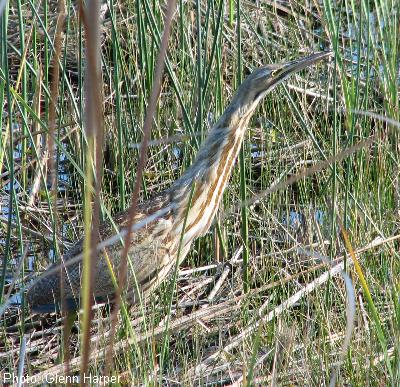
The American Bittern (Botaurus lentiginosus) is a large (60-85 cm [24-33 in]) waterbird with a long, thick neck and long, pointed bill. It is distributed discontinuously from Canada through Mexico, with some populations in Central America and the Caribbean. It feeds on fish, crustaceans, insects, amphibians, reptiles, and small mammals in freshwater marshes. Human use and draining of wetlands has led to habitat loss and degradation, resulting in declining bittern populations. The American Bittern will experience a high degree of climate exposure and has a high adaptive capacity. Overall, it has a Climate Change Vulnerability Index ranking of Less Vulnerable under both Representative Concentration Pathway (RCP) 4.5 and RCP 8.5 Scenarios. The American Bittern’s climate change vulnerability is impacted by factors related to movement, life history, and abiotic niche, which influence its ability to shift in space, persist in place, and respond to climate change impacts. It also has documented or modeled responses to climate change that impact its vulnerability score.