

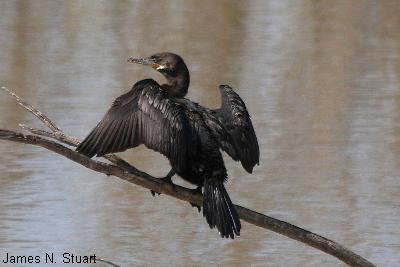
| Scientific Name | Phalacrocorax brasilianus |
| Category | L |
| Taxon | Birds |
| Climate Change Vulnerability Score | Less Vulnerable |
The Neotropic Cormorant (Phalacrocorax brasilianus) is a large (61 cm [24 in]) waterbird with a long body and proportionally long, snake-like neck. It ranges from the tip of South America to the southern US border. In New Mexico, it can be found at Elephant Butte and Caballo Lakes and Bosque del Apache National Wildlife Refuge and occasionally farther north along the Rio Grande. It is always found by water, where it eats fish. The Neotropic Cormorant will experience a high degree of climate exposure and has a moderately high adaptive capacity. Overall, it has a Climate Change Vulnerability Index ranking of Less Vulnerable under both Representative Concentration Pathway (RCP) 4.5 and RCP 8.5 Scenarios. The Neotropic Cormorant’s climate change vulnerability is impacted by factors related to movement, life history, and abiotic niche, which influence its ability to shift in space, persist in place, and respond to climate change impacts.