

| Scientific Name | Choeronycteris mexicana |
| Category | F |
| Taxon | Mammals |
| Climate Change Vulnerability Score | Highly Vulnerable |
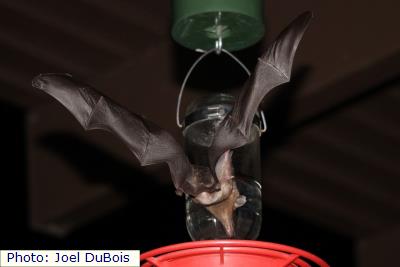
The Mexican Long-tongued Bat (Choeronycteris mexicana) is a small (8 cm [3 in] length) bat that is found from El Salvador, Mexico, southwestern Honduras and Guatemala, and into the US states bordering Mexico. It has been recorded in Hidalgo County, New Mexico. It roosts in caves, rock fissures, old mines, and, occasionally, buildings in a variety of habitats, generally close to food sources. It consumes nectar, fruits, and pollen. The Mexican Long-tongued Bat will experience a high degree of climate exposure and has a moderately low adaptive capacity. Overall, it has a Climate Change Vulnerability Index ranking of Less Vulnerable under the Representative Concentration Pathway (RCP) 4.5 Scenario and Moderately Vulnerable under the RCP 8.5 Scenario. The Mexican Long-tongued Bat’s climate change vulnerability is impacted by factors related to distribution, movement, life history, and abiotic niche, which influence its ability to shift in space, persist in place, and respond to climate change impacts. It also has documented or modeled responses to climate change that impact its climate change vulnerability score.