
| Scientific Name | Basilinna leucotis borealis |
| Category | L |
| Taxon | Birds |
| Climate Change Vulnerability Score | Less Vulnerable |
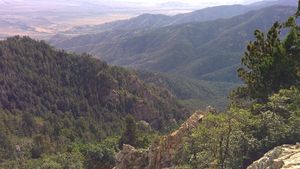
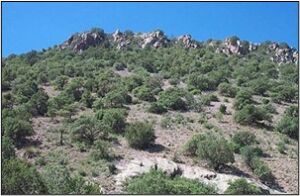
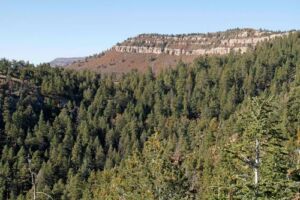
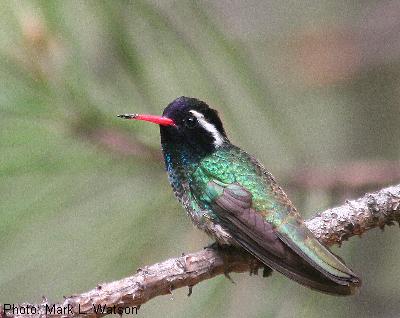
The White-eared Hummingbird (Basilinna leucotis borealis) is a medium-sized hummingbird (9-10 cm long [3.5-4 in]; 3.2-3.6 g [0.1 oz]) with a reddish, black-tipped bill and prominent white "ear" in adults. Males are largely greenish, with a violet crown and throat area; females have a more brownish head and whitish throat. It forages for small insects and flower nectar in pine (Pinus spp.), pine-oak (Quercus spp.), and pine-evergreen forests and forest edges. It occurs from the extreme southwestern US south to Nicaragua. The White-eared Hummingbird will experience a high degree of climate exposure and has a moderately high adaptive capacity. Overall, it has a Climate Change Vulnerability Index ranking of Less Vulnerable under both Representative Concentration Pathway (RCP) 4.5 and RCP 8.5 Scenarios. The White-eared Hummingbird’s climate change vulnerability is impacted by abiotic niche factors, which influence its ability to respond to climate change impacts. It also has documented or modeled responses to climate change that impact its vulnerability score.