
| Scientific Name | Oncorhynchus clarkii virginalis |
| Category | F |
| Taxon | Fish |
| Climate Change Vulnerability Score | Extremely Vulnerable |
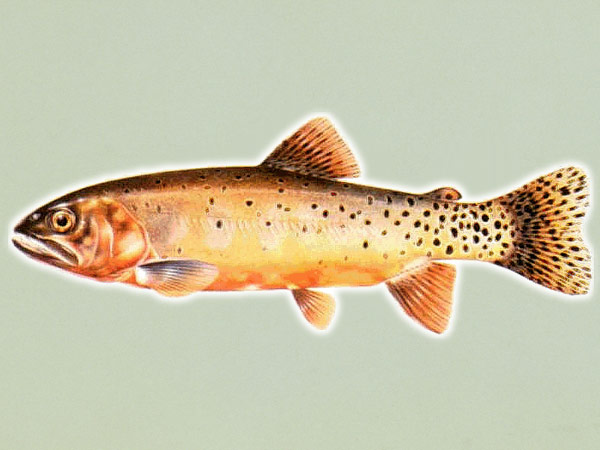
The Rio Grande Cutthroat Trout (Oncorhynchus clarkii virginalis) has two yellowish-orange slashes in its gular folds on either side of the lower jaw, yellowish-green to grayish-brown bodies with black spots more numerous towards the tail, and creamy-white abdomens. It opportunistically feeders on insects, fish, zooplankton, and amphipods. The Rio Grande Cutthroat Trout will experience a high degree of climate exposure and has a low adaptive capacity. Overall, it has a Climate Change Vulnerability Index ranking of Extremely Vulnerable under both Representative Concentration Pathway (RCP) 4.5 and RCP 8.5 Scenarios. The Rio Grande Cutthroat Trout’s climate change vulnerability is impacted by factors related to distribution, life history, evolutionary potential, and abiotic niche, which influence its ability to shift in space, persist in place, and respond to climate change impacts. It is impacted by barriers and other anthropogenic and biologic factors that could increase the effects of climate change. It also has documented or modeled responses to climate change that impact its climate change vulnerability score.