
| Scientific Name | Crotalus scutulatus scutulatus |
| Category | D |
| Taxon | Reptiles |
| Climate Change Vulnerability Score | Less Vulnerable |
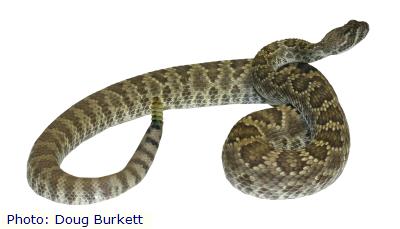
The Mojave Rattlesnake (Crotalus scutulatus scutulatus) is a large (61-129 cm [24-51 in]), highly venomous snake found in the deserts and arid regions of the southwestern US, including Arizona, California, Nevada, and New Mexico. In New Mexico, this species is found in Otero and Hidalgo Counties. Its background color varies from greenish-gray, yellow, tan, and olive-green to brown. It has irregular, dark, well-defined, diamond or near diamond-shaped dorsal markings. It eats a wide variety of smaller animals, lizards, and other snakes. The Mojave Rattlesnake will experience a high degree of climate exposure and has a high adaptive capacity. Overall, it has a Climate Change Vulnerability Index ranking of Less Vulnerable under both Representative Concentration Pathway (RCP) 4.5 and RCP 8.5 Scenarios. The Mojave Rattlesnake’s climate change vulnerability is impacted by factors related to distribution, demography, and abiotic niche, which influence its ability to shift in space, persist in place, and respond to climate change impacts.