Skip to content

NEW MEXICO DEPARTMENT OF WILDLIFE

New Mexico Conservation Information System

  • New Mexico Conservation Information System
  • BISON-M
  • NMERT
  • NM CHAT
  • Share with Wildlife

NEW MEXICO DEPARTMENT OF WILDLIFE

  • New Mexico Conservation Information System
  • BISON-M
  • NMERT
  • NM CHAT
  • Share with Wildlife
New Mexico State Wildlife Action Plan LogoNew Mexico State Wildlife Action Plan Logo

State Wildlife Action Plan for New Mexico

New Mexico State Wildlife Action Plan
  • OVERVIEW
  • Species
    • Amphibians
    • Bees
    • Beetles
    • Birds
    • Crustaceans
    • Fish
    • Flies
    • Mammals
    • Molluscs
    • Moths and Butterflies
    • Reptiles
  • Ecoregions
    • Arizona/New Mexico Mountains
    • Chihuahuan Desert
    • Colorado Plateaus
    • High Plains and Tablelands
    • Madrean Archipelago
    • Southern Rocky Mountains
  • Habitats
    • Alpine and Montane Vegetation
    • Aquatic
    • Arroyo Riparian
    • Cliff, Scree & Rock Vegetation
    • Desert Grassland and Scrub
    • Plains-Mesa Grasslands< Back to Habitats List
    • Riparian Woodlands and Wetlands
  • Conservation Opportunity Areas
  • Threats and Conservation Actions
  • Monitoring
  • Climate Change
  • Related Resources

New Mexico State Wildlife Action Plan

  • OVERVIEW
  • Species
    • Amphibians
    • Bees
    • Beetles
    • Birds
    • Crustaceans
    • Fish
    • Flies
    • Mammals
    • Molluscs
    • Moths and Butterflies
    • Reptiles
  • Ecoregions
    • Arizona/New Mexico Mountains
    • Chihuahuan Desert
    • Colorado Plateaus
    • High Plains and Tablelands
    • Madrean Archipelago
    • Southern Rocky Mountains
  • Habitats
    • Alpine and Montane Vegetation
    • Aquatic
    • Arroyo Riparian
    • Cliff, Scree & Rock Vegetation
    • Desert Grassland and Scrub
    • Plains-Mesa Grasslands< Back to Habitats List
    • Riparian Woodlands and Wetlands
  • Conservation Opportunity Areas
  • Threats and Conservation Actions
  • Monitoring
  • Climate Change
  • Related Resources

Longnose Gar

Back to Species
Longnose Gar
Longnose Gar
Scientific Name Lepisosteus osseus
Category L
Taxon Fish
Climate Change Vulnerability Score Less Vulnerable
View on BISON-M

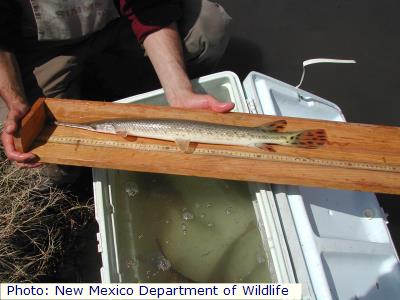
The Longnose Gar (Lepisosteus osseus) is a large (71-122 cm [28-48 in]) freshwater fish found in the Rio Grande, Rio Mimbres, and Rio Yaqui and the Gila and Zuni Rivers. It can breathe both air and water, allowing it to live in areas with lower amounts of oxygen in the water. The Longnose Gar eats primarily at night, and its diet ranges from small fish to insects and small crustaceans. The Longnose Garwill experience a high degree of climate exposure and has a high adaptive capacity. Overall, it has a Climate Change Vulnerability Index ranking of Less Vulnerable under both Representative Concentration Pathway (RCP) 4.5 and RCP 8.5 Scenarios. The Longnose Gar’s climate change vulnerability is impacted by factors related to life history and evolutionary potential, which influence its ability to persist in place and respond to climate change impacts.
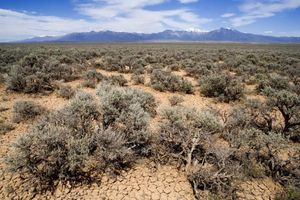
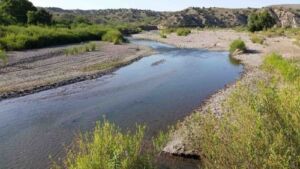
Ecoregions

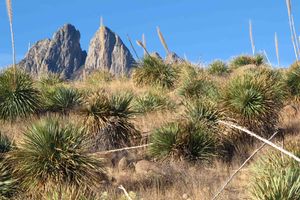
Chihuahuan Desert
Chihuahuan Desert
Colorado Plateaus
Colorado Plateaus

Habitats

Perennial Warm Water Streams

Threats and Conservation Actions

Result for: All
Biological Resource Use
Assess the synergistic effects between climate change and other threats to SGCN and their habitats (e.g., Friggens et al. 2019, Parks et al. 2019). Incorporate appropriate climate adaptation strategies and frameworks into projects designed to address these synergistic effects. This may include enhancing connectivity (CEQ 2023), facilitating a species’ innate adaptive capacity (Thurman et al. 2022), enhancing genetic diversity (Powell 2023), considering local adaptation (Meek et al. 2023), or considering whether it is most appropriate to resist, accept, or direct ecosystem transformation (Lynch et al. 2021, Stevens et al. 2021). Projects should acknowledge ecosystem dynamism and incorporate indigenous knowledge (e.g., Roos et al. 2022, Eisenberg et al. 2024), nature-based solutions (Warnell et al. 2023), and experimentation (Guiterman et al. 2022) when appropriate. Potential collaborators: BLM, NPS, USFS, USFWS, USGS, universities, Tribal natural-resource managers.

Biological Resource Use
Collaborate with interested and willing land managers and private landowners to designate protected areas or implement conservation easements for lands that encompass important SGCN habitats. Potential collaborators: BLM, NPS, NRCS, USFS, USFWS, SLO, non-profit organizations, private landowners.

Biological Resource Use
Determine life history needs, ecology, distribution, movements, status, and trends of and threats to SGCN (especially invertebrates that are not currently monitored, riparian-obligate species, herpetofauna [Pierce et al. 2016, Olson and Pilliod 2022], and rare native fishes) and their habitats. Consider full annual cycles for migratory species when appropriate and logistically feasible (KFF 2021) and interactions with lower trophic levels that may drive SGCN status (e.g., EPA 2023). Use this information to develop and implement effective monitoring protocols and conservation actions, including actions to mitigate identified threats. Potential collaborators: BLM, BOR, NPS, USFS, USFWS, SLO, universities, non-profit organizations, private industry, species working groups, Tribal natural-resource managers.

Biological Resource Use
Determine the distribution (historic, current, and future), composition, disturbance regimes, and function of piñon (Pinus spp.)-juniper (Juniperus spp.) woodlands and savannas needed by SGCN and SGCN prevalence in these habitats. Potential collaborators: BLM, NPS, USFS, USFWS, universities, private landowners, Tribal natural-resource managers.

Biological Resource Use
Enforce laws that protect SGCN populations that are often collected illegally, especially reptiles and amphibians. Longer-lived species, such as turtles, may be especially threatened by over-collection (Fitzgerald et al. 2004). Potential collaborators: BLM, DOD, NPS, USFS, USFWS, SLO.

Biological Resource Use
Evaluate the effectiveness of public education and outreach efforts regarding threats to SGCN and their habitats and the ways that the public can assist in threat mitigation (KFF 2021). Modify outreach activities as needed in response to evaluation outcomes. Potential collaborators: BLM, BOR, NPS, USACE, USFS, USFWS, USGS, NMED, NMSP, SFD, SLO, universities, local governments, municipalities, non-profit organizations.

Biological Resource Use
Identify or develop an accessible, jointly used database to document the status and condition of, threats to, and conservation actions implemented across aquatic, riparian, and upland habitats. Identify data gaps (e.g., Ganey et al. 2017) and implement standardized methods to gather habitat data (e.g., Vollmer et al. 2018, Shirk et al. 2023) and to monitor the success of conservation actions (e.g., Davis and Pinto 2021), including impacts on local SGCN populations. Synthesize existing information (e.g., Jain et al. 2021) and apply modeling techniques to aid in evaluating success when appropriate (e.g., Parks et al. 2018). Adjust future conservation actions as needed based on observed outcomes. Potential collaborators: BLM, BOR, NPS, USACE, USFS, USFWS, USGS, NMED, SFD, SLO, universities.

Biological Resource Use
Inform natural-resource law enforcement staff of the distribution, life history, and habitat needs of SGCN. Partner with them to enforce laws to protect SGCN populations and habitats. Potential collaborators: BLM, NPS, USFS, USFWS.

Biological Resource Use
Support programs that educate the public about the importance of not illegally collecting or harassing SGCN, especially reptiles and amphibians (Pierce et al 2016). Potential collaborators: BLM, DOD, NPS, USFS, USFWS, SLO.

Biological Resource Use
Work with landowners and land-management agencies to use forests, woodlands (including piñon-juniper woodlands), and savannas in a manner that maintains healthy, and returns degraded, vegetation to an improved composition and function for SGCN, while protecting grassland communities surrounding piñon-juniper woodlands from woody plant invasion. Potential collaborators: BLM, DOD, NPS, USFS, SFD, SLO, private landowners.

Related Resources

  • Species of Greatest Conservation Need Chapter in SWAP document
Natural Heritage New Mexico
  • Contact Us
  • Our Mission
  • Work With Us
  • Operation Game Thief
  • Contact Us
  • Our Mission
  • Work With Us
  • Operation Game Thief

©2026 • New Mexico State Wildlife Action Plan • All Rights Reserved • Website by Delta Systems

Page load link
Go to Top