
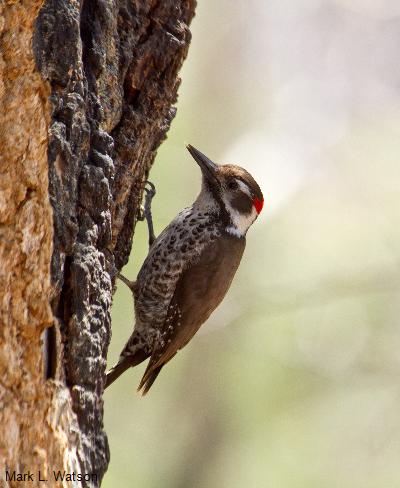
| Scientific Name | Dryobates arizonae |
| Category | L |
| Taxon | Birds |
| Climate Change Vulnerability Score | Less Vulnerable |
The Arizona Woodpecker (Dryobates arizonae) is a small woodpecker (18-20 cm long [7-8 in]; 34-51 g [1-2 oz]) with a brown back, brown and white with red (for males) head, and white belly with brown spots. It forages in tree bark and other places for beetle larvae, berries, acorns, and insects. It occurs in southeastern Arizona, southwestern New Mexico, and south well into Mexico. The Arizona Woodpecker will experience a high degree of climate exposure and has a high adaptive capacity. Overall, it has a Climate Change Vulnerability Index ranking of Less Vulnerable under both Representative Concentration Pathway (RCP) 4.5 and RCP 8.5 Scenarios. The Arizona Woodpecker’s climate change vulnerability is impacted by factors related to distribution and life history, which influence its ability to shift in space and persist in place. It also has documented or modeled responses to climate change that impact its vulnerability score.