

| Scientific Name | Lagopus leucura altipetens |
| Category | F |
| Taxon | Birds |
| Climate Change Vulnerability Score | Highly Vulnerable |
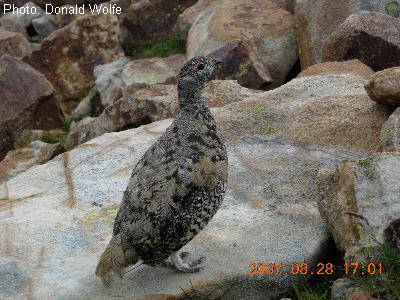
The White-tailed Ptarmigan (Lagopus leucura altipetens) is a small (30-31 cm [12 in]) grouse with a thick body and white tail and wings. In the winter, it is completely white and it has grayish-brown barring in the summer. The core of its distribution is in western Canada and Alaska. It is also disjunctly distributed through the Rocky Mountains, south to northern New Mexico. In New Mexico, it is found in the Sangre de Cristo Mountains. It lives in alpine habitats with bare rock and talus slopes. Alpine willows (Salix spp.) are important food sources for the White-Tailed Ptarmigan, especially during the winter months. The White-tailed Ptarmigan will experience a high degree of climate exposure and has a moderately high adaptive capacity. Overall, it has a Climate Change Vulnerability Index ranking of Highly Vulnerable under both Representative Concentration Pathway (RCP) 4.5 and RCP 8.5 Scenarios. The White-tailed Ptarmigan’s climate change vulnerability is impacted by factors related to distribution, evolutionary potential, and abiotic niche, which influence its ability to shift in space and respond to climate change impacts. It is impacted by anthropogenic or topographic barriers and other biologic factors that could increase the effects of climate change. It also has documented or modeled responses to climate change that impact its vulnerability score.