

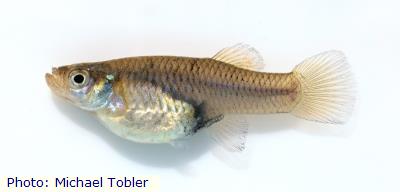
| Scientific Name | Gambusia nobilis |
| Category | F |
| Taxon | Fish |
| Climate Change Vulnerability Score | Extremely Vulnerable |
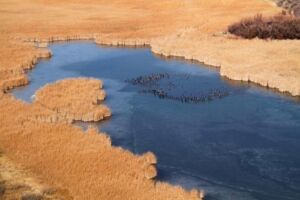
The Pecos Gambusia (Gambusia nobilis) is a small (4 cm [2 in]) fish that occurs in the Pecos River basin in New Mexico and Texas, though its distribution has been greatly restricted in recent years primarily due to introduced species and the lowering of water tables. In New Mexico, it is now mainly found in the Bitter Lake National Wildlife Refuge and Blue Spring. It inhabits pools and outflows of clear, vegetated springs with high calcium carbonate levels and gypsum sinkholes. It does not do well when competitors (e.g., Western Mosquitofish [Gambusia affinis]) or predators (e.g., Green Sunfish [Lepomis cyanellus]) are present. The Pecos Gambusia will experience a high degree of climate exposure and has a low adaptive capacity. Overall, it has a Climate Change Vulnerability Index ranking of Extremely Vulnerable under both Representative Concentration Pathway (RCP) 4.5 and RCP 8.5 Scenarios. The Pecos Gambusia’s climate change vulnerability is impacted by factors related to distribution, life history, evolutionary potential, and abiotic niche, which influence its ability to shift in space, persist in place, and respond to climate change impacts. It is also impacted by barriers, land-use changes, and other anthropogenic and biologic factors that could increase the effects of climate change.